


Hinamatsuri Explained: Japan’s Girls’ Day and Its Traditions
Hinamatsuri (雛祭り), celebrated each year on March 3, is one of Japan’s five seasonal festivals and is widely known as Girls’ Day or the Doll Festival. Families with daughters display ornate hina dolls, prepare symbolic foods, and pray for their children’s health and happiness. Originating in ancient purification rituals and court culture, read on to learn more about the festival and how it has evolved over centuries while retaining its core imagery and customs.
What Is Hinamatsuri?
Hinamatsuri (雛祭り) is a traditional Japanese festival celebrated on March 3rd each year to honor young girls and pray for their health and happiness. It is often called Girls’ Day or the Doll Festival (雛祭り) because of the decorative hina doll displays, and it’s one of Japan’s five seasonal sekku festivals, which were originally adopted from Chinese calendrical traditions and became established in Japan as court observances tied to seasonal change and purification rituals.
Hinamatsuri is also known as the Peach Festival (桃の節句, Momo no Sekku), because in the old lunar calendar this occasion coincided with the blooming of peach blossoms. Families with daughters mark this day by displaying ornate dolls and sharing special foods, all with the hope of ensuring their girls grow up healthy, happy, and prosperous.
Historical Origins of Hinamatsuri
The origins of Hinamatsuri can be traced to ancient purification rituals that date back over a thousand years. The festival’s origin is linked to China’s Shangsi Festival (the “Double Third” festival held on the third day of the third lunar month), where people would cleanse themselves in rivers on that day to ward off bad luck.
When this custom came to Japan, it merged with native Shinto purification practices. As early as the Heian period (794–1185), the Japanese would rub their bodies with paper or straw dolls (人形, hitogata) to transfer misfortunes onto them and then float the dolls down rivers, a ritual known as hina-nagashi (雛流し). This “doll floating” ceremony was believed to carry away evil spirits and illness with the dolls, purifying the person in the process.
Around the same time, aristocratic doll play known as hina-asobi (雛遊び) became popular among noble girls. Over the centuries, these two elements, the ritual use of dolls for purification and play with decorative dolls, gradually fused together. By the Heian period, the third day of the third month (known as Jōshi no Sekku 上巳の節句) was observed with both purification rites and display of dolls, laying the foundation for Hinamatsuri.
In the Edo period (1603–1868), the custom spread beyond the aristocracy and became a household celebration. Doll displays grew more complex, arranged on tiered platforms to reflect court hierarchy. It was during this period that the festival became specifically associated with girls, emphasizing wishes for their health, refinement, and future marriage.

The Meaning of the Hina Doll Display
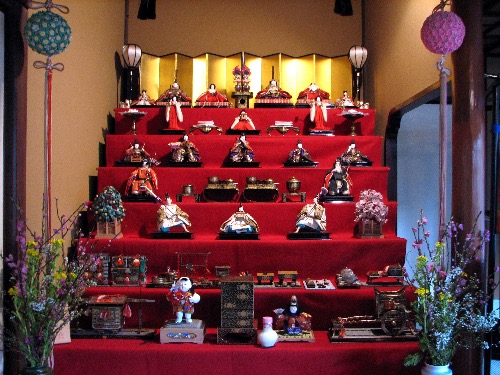
The centerpiece of Hinamatsuri is the hina doll display (hina ningyō 雛人形), a set of ornamental dolls arranged on a tiered platform (hina-dan) covered with a red cloth. These dolls represent a Heian era imperial court, and the display is essentially a miniature royal wedding scene meant to symbolize good fortune for girls.
The custom of displaying hina dolls is believed to invite good luck and act as a prayer for the girl’s future, ensuring she will be healthy, happy, and eventually blessed with a good marriage.
Each figure’s position recreates the hierarchy of an ancient court. A full seven tier set (a five tier set is also common) typically has 15 dolls: the top tier has the seated imperial couple known as Odairi-sama (the Emperor) and Ohina-sama (the Empress); the second tier holds three court ladies (sannin kanjo); the third tier has five male court musicians (gonin bayashi); the fourth holds two ministers or guardian figures; and the fifth tier has three helpers or attendants.
The bottom tiers, the sixth and seventh, are filled with tiny furniture, dishes, ceremonial objects, and other props; the full arrangement recreates an idealized image of the imperial court, reflecting elegance, order, and refinement.
The reason these dolls represent the imperial household lies in the festival’s Heian period roots, when court culture set social standards. Displaying the imperial couple symbolized harmony and a prosperous marriage, values historically associated with a daughter’s future. There is also a belief that hina dolls absorb bad luck or misfortune in place of the children; in essence, the displayed dolls act as guardians of the girl, taking on any evil spirits that might threaten her.
Another popular custom is that families should put the dolls away promptly after March 3, as it is said that displaying dolls past March 4 means the girl will marry late in life. While not everyone takes this seriously, the custom persists. On a practical note, early March in Japan is still dry and cool; soon after, the humid rainy season begins, which could damage the delicate dolls.
Food Traditions and Their Meaning
No festival is complete without special foods, and Hinamatsuri has its own colorful menu of traditional dishes and sweets. Each item served on Girls’ Day carries a symbolic blessing for health or fortune:
Chirashi-zushi (ちらし寿司): “Scattered” sushi, a bowl of vinegared rice topped with ingredients such as shrimp, vegetables, omelette strips, and lotus root. The variety of toppings represents abundance and prosperity, while certain ingredients carry specific meanings, for example shrimp for longevity and lotus root for foresight into the future.

Hina-arare (雛あられ): Bite-sized rice crackers or puffs, often colored pink, white, green, and yellow. They can be sweet or savory, depending on the region; in Kanto they are sweet puffs, while in Kansai they are often savory soy sauce flavored crackers. The pastel colors reflect spring and good health.

Hishimochi (菱餅): Diamond-shaped rice cakes stacked in three layers: pink (top), white (middle), and green (bottom). Pink represents peach blossoms and spring energy, white symbolizes snow and purity, and green stands for health and growth. The diamond shape is associated with fertility and protection; hishimochi are typically placed on the doll display as an offering.

Shirozake (白酒) or Amazake (甘酒): The traditional drink is shirozake, a sweet white sake made from fermented rice. Amazake is usually nonalcoholic, while shirozake contains a small amount of alcohol. For this reason, shirozake is traditionally served to adults, and children drink nonalcoholic amazake. The white color symbolizes purity.

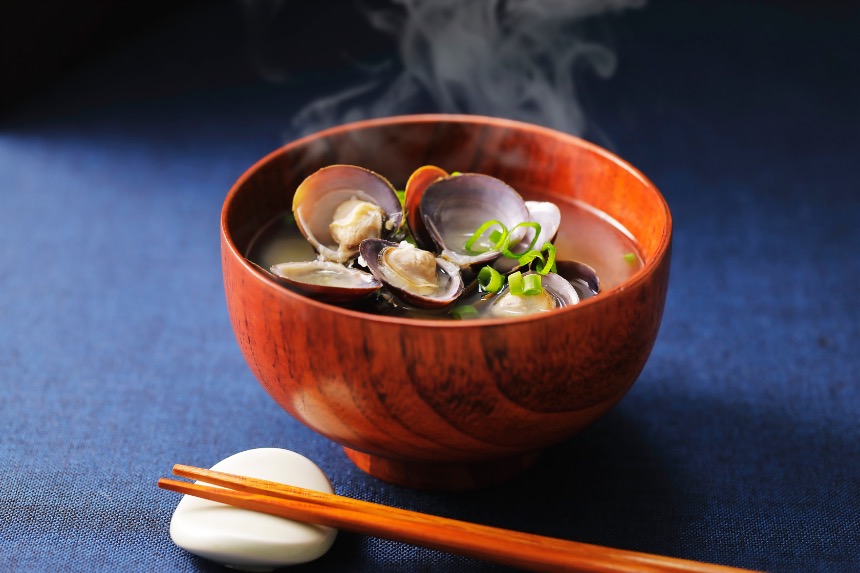
Clam Soup (蛤のお吸い物, hamaguri osuimono): A clear broth with hamaguri clams. Because clam shells fit only with their matching pair, they symbolize harmony and a good marriage, while the clear soup represents a clear path in life.
Sweets: Other sweets enjoyed around Hinamatsuri include sakura-mochi (桜餅), pink rice cakes filled with sweet bean paste and wrapped in a salted cherry leaf. In some regions, people also eat 草餅 (kusa-mochi) which is a green mugwort rice cake. In Kyoto, a local sweet called hichigiri (ひちぎり) is also popular.

Hinamatsuri in Modern Japan
Today, Hinamatsuri remains widely recognized, though the way it is celebrated has evolved. Many families with young daughters still display hina dolls at home, but not every family has the space or budget for a full seven tier doll set, as these sets, often handcrafted with real silk brocade costumes and ornate accessories, can be quite expensive, ranging from hundreds to thousands of dollars (a good quality five-tier set might cost $1500–$2500). Some families choose a smaller set, often just the top tier couple or a compact three tier arrangement, especially in urban apartments where space is limited.
Some regions host Hinamatsuri events; a standout example is the Katsuura Big Hina Matsuri held in Katsuura City, Chiba. Every year, this seaside town displays thousands of hina dolls throughout the town. The highlight is the 60-step stairway at Tomisaki Shrine, covered with around 1,500 dolls. Many of these are donated by families across Japan who can no longer store or use their sets and send them to be part of the celebration.
The festival includes parades of children in traditional dress and attracts many visitors each year. There is also an indoor display of around 7,000 dolls in the city hall.
Another popular festival is the Kasuisai Hina Matsuri at Kasuisai Temple in Fukuroi City, Shizuoka Prefecture. Held annually from January 1 to March 31, the temple displays around 1,200 hina dolls arranged on a massive 32 tier platform that fills the large hall on the second floor of Zuiryukaku.
Celebrations can also vary by region. In some areas, such as Kyoto, hina-nagashi purification rituals are still performed, while differences in doll arrangement and style reflect historical distinctions between regions such as Kyoto and the Kanto area.
In eastern Japan, including Tokyo, the standard today is to place the male doll on the left and the female doll on the right from the viewer’s perspective. In western Japan, including Kyoto and the Kansai region, many displays reverse this arrangement, placing the male on the right and the female on the left. The Kyoto style reflects the older convention; in the Heian court, the Emperor was traditionally seated to the right of the Empress in formal ceremonies.

Gender Expectations and Social Meaning
Hinamatsuri is specifically known as Girls’ Day because it developed around wishes for daughters’ health, refinement, and future stability. Historically, the emphasis was not only on wellbeing but also on qualities associated with ideal womanhood in premodern Japan, including grace, harmony, and preparation for marriage. The imperial court imagery in the hina display reinforced these expectations, presenting a model of orderly domestic and social roles.
The festival is often compared with Children’s Day on May 5, which was originally known as Boys’ Day (Tango no Sekku). Boys’ Day traditionally highlighted strength, bravery, and martial values, reflected in samurai imagery. After World War II, May 5 was officially renamed Children’s Day to represent all children.
Contemporary Debate and Changing Perspectives
In recent years, there has been more open discussion in Japan about gender roles, and Hinamatsuri has come under some critical scrutiny. Some argue that Hinamatsuri reinforces traditional gender norms by focusing on girls separately and idealizing them as “doll-like princesses”. The festival’s imagery of brides and court ladies can be seen as promoting the notion that a woman’s happiness equals marriage and refinement.
People also point out that Hinamatsuri, in its conventional form, emphasizes beauty, obedience, and marriage for girls. The exclusion of boys from the celebration and the strong association with heterosexual marriage have also been questioned considering today’s more diverse understanding of gender and family.
Additionally, the practice of using dolls to carry away evil was specifically aimed at girls’ misfortune, which some interpret as established in older superstitions about female impurity.
On the other hand, many people defend Hinamatsuri as a valuable cultural tradition that honors girls and women in a positive way. It is an occasion when girls are the center of attention within the family, in a society where boys were traditionally favored.
Contemporary attitudes are gradually shifting the meaning of the day. Some parents use Hinamatsuri not only to wish their daughters marriage and happiness in a traditional sense, but also to talk about their dreams, education, and empowerment, celebrating girls’ ambitions and strengths rather than only their conventional roles. Importantly, even those who critique certain aspects of the tradition usually do not call for abolishing Hinamatsuri; instead, they discuss updating its message.

Reading Between the Dolls

Hinamatsuri has evolved from ancient purification rituals and courtly customs into a widely observed family celebration that continues to adapt to modern society. While its traditional imagery reflects historical ideals about girlhood and marriage, contemporary interpretations increasingly emphasize health, education, and personal aspirations. The festival illustrates how Japan preserves seasonal traditions while allowing their meaning to change over time.
🎎 Invest in Your Growth
Hinamatsuri centers on hopes for growth and future success. If you’re thinking about your own development, gaining international experience through an internship in Japan can strengthen both your skills and perspective. Join the program to take that step, or reach out to us to find internships in Japan suited to your field!


